
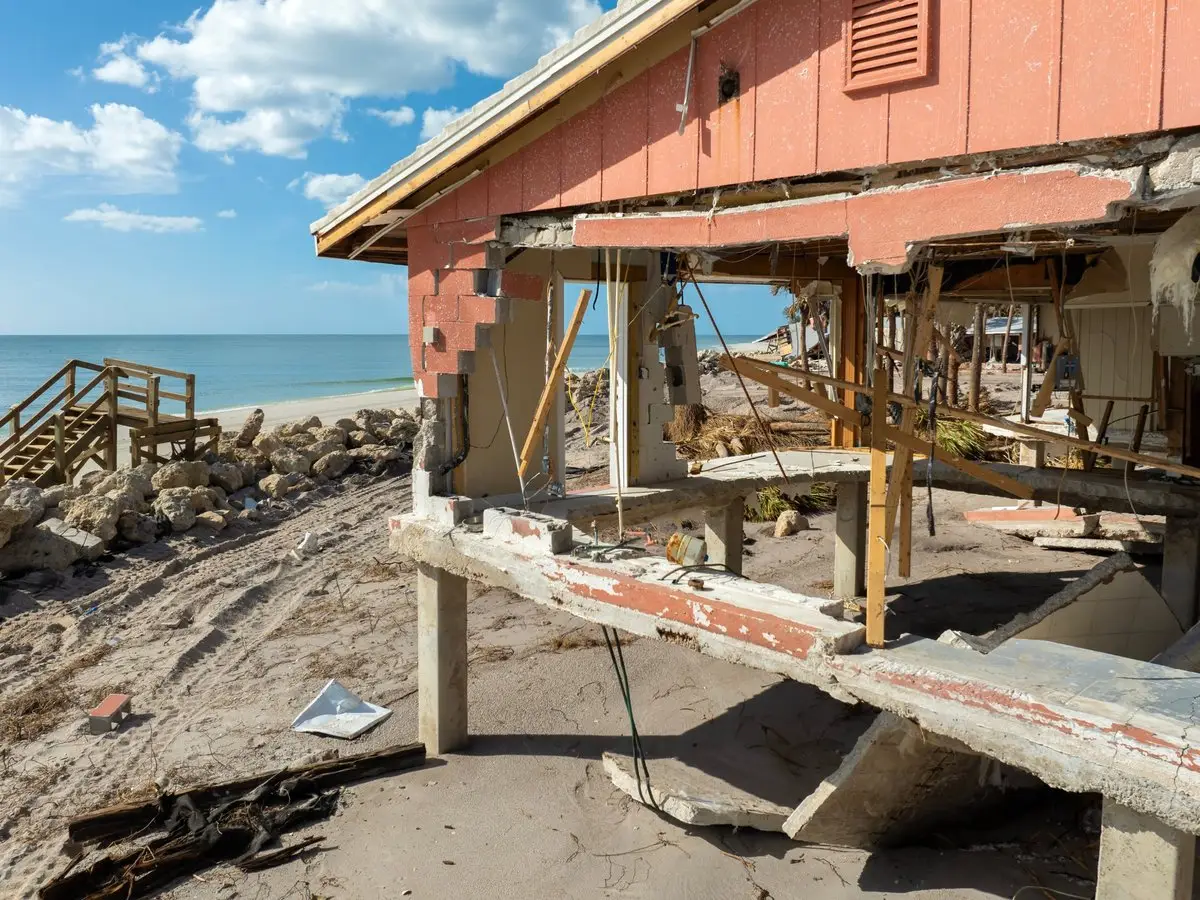
Executive Summary
- The rule: If repairing a storm-damaged building in a Special Flood Hazard Area costs 50% or more of its pre-storm market value (land excluded), the whole structure must be brought up to current floodplain code, usually meaning elevation.
- Who decides: Your local building official or floodplain manager makes the call, not FEMA. In Pensacola that means the City or Escambia County; in Panama City, the City or Bay County.
- The options: Elevate, relocate, or demolish and rebuild to code. Flood policyholders may claim up to $30,000 in Increased Cost of Compliance (ICC) coverage, which can be put toward demolition.
After a Gulf Coast hurricane, most owners ask “how much to fix it?” In a flood zone, the better question is “am I allowed to fix it as-is?” Here is how the 50% rule works in Escambia County, Bay County, and across the Florida Panhandle.
What Is Florida’s 50% Substantial Damage Rule?
The 50% rule is a National Flood Insurance Program (NFIP) requirement that applies to buildings in flood zones starting with A or V. A structure is “substantially damaged” when restoring it to its pre-damage condition would cost 50% or more of the building’s market value before the damage.
The cause of damage does not matter. Wind, surge, fire, or a fallen oak all count toward the total.
Florida communities enforce the rule through local floodplain ordinances and the Florida Building Code, which keeps NFIP flood insurance available to local owners.
Who Decides If My Home Is Substantially Damaged?
Your local building official or floodplain administrator decides, not FEMA. FEMA may supply damage data after a major storm, but the determination letter comes from your city or county.
In Escambia County, a substantially damaged building must meet county floodplain rules, which can mean raising it to or above the base flood elevation. You can review the county’s process on the Escambia County flood repair permitting page.
You can usually challenge the market value used in the math. Most counties start with the property appraiser’s building value, and many accept an independent appraisal using the cost approach.
How Is the 50% Calculation Made?
The building official divides the full cost of repairs by the pre-damage market value of the structure alone. If a house is valued at $200,000 and repairs total $105,000, the ratio is 52.5%, and the home is substantially damaged.
What goes into that repair number matters a great deal:
| Counted Toward 50% | Not Counted Toward 50% |
|---|---|
| Structural framing, roofing, load-bearing walls | Land value |
| Electrical, plumbing, HVAC | Plans, surveys, and permit fees |
| Drywall, flooring, cabinets, built-in appliances | Debris removal and site cleanup |
| Contractor overhead, profit, and labor (including owner or volunteer labor) | Furniture and plug-in appliances |
| Interior demolition tied to repairs | Pools, fences, driveways, detached sheds |
Florida’s 2025 law (SB 180) also bars NFIP communities from using multi-year “lookback” periods that stacked older permits into the calculation. Storm repairs from a single event are still evaluated together, so confirm the current approach with your permit office.
Repair, Elevate, or Demolish: Your Three Paths
Once a home crosses the 50% line, owners generally choose among these options:
- Elevate the existing structure to meet base flood elevation. This works best on sound, lighter wood-frame homes, and it costs significantly more for slab-on-grade block construction.
- Relocate the building to higher ground on the same lot or a new one. This is rare in the Panhandle due to cost and lot size.
- Demolish and rebuild to code. A new structure built on elevated pilings or engineered dirt backfill meets current standards from day one.
For many older slab homes along Pensacola Bay and Panama City’s waterfront neighborhoods, elevation costs approach or exceed new construction. That is when a structural tear-down becomes the smarter investment.
Does Flood Insurance Help Pay for Demolition?
Yes, if you carry an NFIP policy and the substantial damage came from flooding. Increased Cost of Compliance coverage pays up to $30,000 toward elevating, relocating, or demolishing a substantially damaged building, on top of the standard claim payout.
Owners must generally file the ICC request within 60 days of receiving the substantial damage notice. Our guide to demolition insurance claims in Florida walks through working with adjusters on this step.
FEMA’s substantial damage determinations fact sheet outlines the federal side of the process.
Is a Storm-Damaged Structure Safe to Demolish Yourself?
No. Storm-damaged buildings carry hidden hazards, including compromised load-bearing walls, saturated roof decks, live service drops, and asbestos in pre-1980 materials.
Our crews treat every damaged structure as unstable until proven otherwise. Every project follows strict OSHA compliance, including:
- Engineering surveys before any wall comes down
- 811 utility locates and confirmed disconnects for power, gas, water, and sewer
- Dust containment and water suppression during structural tear-downs
- High-reach excavators that keep workers out of the collapse zone
We handle turnkey permitting with the City of Pensacola, Escambia County, Panama City, and Bay County, and provide upfront itemized pricing before mobilization. Learn more about our hurricane demolition services across Northwest Florida.
What Does a Finished Lot Look Like?
A finished lot is graded, compacted, and ready for your builder’s elevated foundation. We remove the slab, footings, and debris, recycle concrete through on-site or off-site concrete crushing, and finish with engineered dirt backfill and grading.
That is our 100% clean lot guarantee. No buried debris, no surprise footings, no leftover nails in the sand for your builder to find.
If your Gulf Coast property just received a substantial damage letter, call Demolition Pros for a site assessment and a written, itemized estimate within 24 hours.